Sep 09,2026
If you run a printing house, packaging plant, or paper mill, you know that converting jumbo rolls into accurately cut, neatly stacked sheets is more complex than it looks.The process involves more than simply cutting—it requires precise tension management, accurate registration, and careful handling to maintain sheet flatness and edge quality. A sheeting machine—also called a paper sheeter or roll-to-sheet cutter—is the equipment that performs this conversion. But how do these machines work? What determines whether a sheet is square, flat, and within tolerance? And how do you choose the right one?
This guide answers these questions by walking you through the complete roll-to-sheet cutting process, explaining each machine component, and providing a practical framework for equipment selection. Whether you are new to sheeting or evaluating an upgrade, you will find actionable insights to make an informed decision. This guide explains the roll-to-sheet cutting process, the components that make up a sheeting machine, the specifications that matter, and a practical framework for selecting equipment that fits your production needs.
What Is a Sheeting Machine?
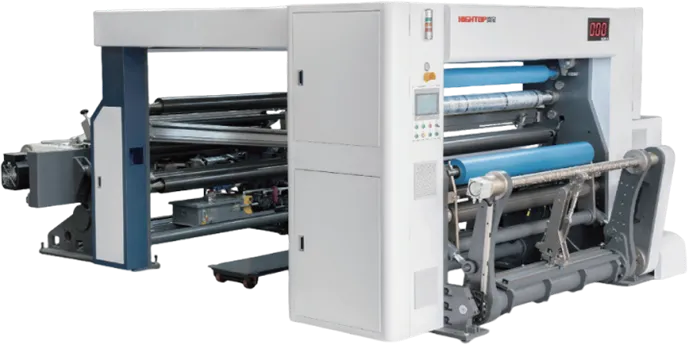
A sheeting machine (or paper sheeter) is a converting machine that cuts a parent roll of paper, board, or other web materials into sheets of predetermined dimensions. It unwinds the large roll, trims edges, cuts the web crosswise into individual sheets, and stacks them—all in one continuous, automated process.
The output of a sheeting machine is a finished stack of sheets, ready for downstream operations such as offset printing, digital printing, packaging, or converting into finished products. Unlike a guillotine cutter that works on pre-stacked piles, a sheeting machine operates inline with unwinding and stacking, offering superior speed, accuracy, and waste reduction.
Modern sheeting machines have evolved significantly from early mechanical designs. Today, they use servo drives, touch-screen controls, and automatic pile handling, making them essential for high-volume operations in paper mills, commercial printing, and packaging production.
A sheeting machine converts jumbo rolls into finished sheets—the exact opposite output of a slitting rewinding machine, which converts rolls into narrower rolls. For applications requiring both processes, many converters operate both types of equipment in sequence.
How Roll-to-Sheet Cutting Works
The roll-to-sheet cutting process follows a continuous workflow from unwinding to finished stacks:
1. Unwinding
The parent roll is mounted on an unwind stand. Brakes or motorized drives maintain constant tension as the web feeds into the machine.
2. Web Control
The web passes through tension control, edge guiding, and decurling sections to ensure flat, straight feed.
3. Cross Cutting
The cutting section—using rotary or guillotine-style knives—cuts the moving web to the exact sheet length.
4. Conveying
Cut sheets are transferred from the cutting section to the stacking area via conveyor belts.
5. Stacking
Sheets are counted, aligned, and stacked on pallets or layboys in perfect alignment.
6. Finished Sheets
The completed stack is ready for packaging, printing, or further converting.
The entire workflow operates at speeds that can exceed 300 meters per minute, with modern servo-controlled machines performing hundreds of cuts per minute while maintaining tolerances in the tenths of a millimeter. The key to this performance lies in the coordination between the feeding, cutting, and stacking sections—each must operate in precise synchronization to produce consistently accurate sheets.
Main Components of a Sheeting Machine
A modern sheeting machine integrates several subsystems whose combined performance determines final sheet quality.
Unwinder (Reel Stand)Holds the parent roll and feeds the web into the machine. Configurations include single-roll and multi-roll stands (2, 4, or more rolls simultaneously). The unwind stand must accommodate the maximum roll diameter and weight your operation requires. Hydraulic shaftless unwind stands can handle rolls up to 3 tons with diameters up to 1800mm. Shaftless designs allow faster roll changes because operators do not need to insert a shaft through the core—the chucks grip the roll ends directly.
Feeding System
Transports the web from the unwind to the cutting section. Includes draw rolls, pinch rolls, and anti-static rollers for smooth material handling.The feeding section is critical for maintaining sheet length accuracy. Draw rolls pull the web from the unwind at a controlled rate, while pinch rolls maintain tension through the cutting zone. Anti-static rollers prevent material cling and misalignment, particularly important for thin papers and films.
Tension Control System
Maintains consistent web tension throughout the machine. Tension directly affects sheet size consistency—when tension varies, sheet length can drift and width can become inconsistent. Advanced systems use dancer rollers or load cells with digital controllers that respond quickly to roll diameter and speed changes. Open-loop systems rely on preset tension values, while closed-loop systems provide real-time feedback and adjustment. For converters running multiple materials, a closed-loop system with recipe storage is essential.
Decurler Unit
Removes curl from roll-fed material before cutting. Paper stored on rolls naturally develops curl due to the winding process. Without proper decurling, sheets will be wavy or curled, causing feeding problems in downstream equipment like offset presses and digital printers. Independent decurler units can automatically adjust decurling degree based on paper condition, contributing to sheet flatness.
Cutting Unit
The heart of the machine. Rotary or guillotine-style knives cut the moving web to exact sheet length. The cutting unit determines the machine's maximum speed and accuracy capabilities. Key factors include knife geometry, material, and the precision of the knife drive system. Servo-controlled cutting provides precision and repeatability, with encoder feedback ensuring each cut occurs at exactly the right moment.
Conveyor System
Transfers cut sheets from the cutting section to the stacking area.The conveyor must transport sheets without disturbing their alignment. Overlapping conveyors, where sheets are slightly overlapped to increase throughput, are common in high-speed machines. The conveyor speed must be coordinated with the cutting speed to maintain consistent sheet spacing.
Stacking System
Counts, aligns, and stacks sheets. Automatic stacking systems can achieve stack heights up to 1500mm with neat alignment. Options include conveyor output for manual handling or fully automatic pallet stackers. Stacking systems typically include sheet counting, jogging (vibrating sheets into alignment), and a layboy or pallet platform that lowers as the stack builds.
Control System
PLC-based controls with HMI touchscreens allow operators to change sheet lengths on the fly, monitor production data, and store recipes for different jobs. Siemens PLC systems are common in high-end equipment.Recipe storage is particularly valuable for converters running frequent changeovers—operators can recall optimized settings for each material and sheet size, reducing setup time and minimizing trial waste.
Rotary vs Guillotine / Cross-Cutting Methods
For sheeting machines, there are two primary cutting technologies: rotary cutting and guillotine (stop-start) cutting. HighTop manufactures rotary sheeters across its GDHQ, ZHQ, and HQJ series.
Rotary Sheeter
A rotary shear uses a rotating knife cylinder that cuts the web continuously. The knife rotates into cutting engagement with the web at programmed intervals.Rotary sheeters operate on a continuous motion principle. The web runs at constant speed, and the rotary knife cylinder rotates in synchronization with the web speed. When the programmed sheet length is reached, the knife engages and cuts—all without stopping or slowing the web. This continuous operation enables higher production speeds and reduces wear on drive components compared to start-stop mechanisms.
| Feature | Rotary Sheeter | Guillotine Sheeter |
|---|---|---|
| Cutting action | Continuous, moving web | Decelerate-stop-cut-restart cycle |
| Speed | High (up to 300 m/min) | Lower |
| Edge quality | Clean cut, minimal dust | Can be rougher |
| Best for | High-volume, thin to medium materials | Very thick board |
| Productivity | Continuous production | Intermittent production |
Guillotine Sheeter
A guillotine shear uses a moving knife blade that comes down onto the paper, which is held in place during the cut. It operates on a decelerate-stop-cut-restart cycle.The guillotine principle is mechanically simpler than rotary cutting but introduces start-stop dynamics that limit speed. The web must decelerate, stop while the cut is made, then accelerate back to operating speed. This makes guillotine sheeters better suited for very thick materials where rotary cutting would require excessive knife force or produce unacceptable edge quality.
Application guidance:
-
Rotary sheeters are the standard for high-volume paper converting, offering speed, clean cuts, and low dust
-
Guillotine sheeters are typically used for very thick board where rotary cutting may struggle
Which Materials Can Be Sheet Cut?
Sheeting machines process a wide range of materials. The machine must be configured for the specific material type and thickness range.
| Material | Typical GSM Range | Key Consideration |
|---|---|---|
| Paper (offset, copy, coated) | 40–300 gsm | Speed, clean cuts, minimal dust |
| Kraft paper | 60–550 gsm | Long fibers cause rough edges; tungsten steel blades extend life |
| Coated paper | 60–550 gsm | Surface protection, tension stability |
| Cup paper | 150–350 gsm | Consistent stacking, square cuts |
| Duplex board / Cardboard | 350–800 gsm | Edge bursting, dust, uneven stacking; heavy-duty knife set required |
| Foil / laminates | Varies | Low tension, anti-scratch surfaces |
GSM range matters because both knives and the feeding system must be adjusted according to material thickness. Without proper calibration, issues such as unstable feeding, rough edges, and material jams occur.
Beyond GSM, other material properties affect sheeting performance:
-
Fiber orientation affects cutting force required and edge quality
-
Moisture content influences sheet flatness and dimensional stability
-
Coating type (clay, silicone, PE) may require special blade materials
-
Static charge can interfere with stacking and alignment
Important Specifications
Understanding machine specifications is essential. Here is what each specification means for your operation.
| Specification | What It Measures | Why It Matters |
|---|---|---|
| Max web width | Widest roll the machine can accept | Determines the largest parent roll you can process |
| Sheet length range | Minimum and maximum sheet length | Ensure the machine handles both your smallest and largest sheet sizes |
| Cutting speed | Sheets per minute or meters per minute | Higher speed = higher throughput; balance with accuracy needs |
| Cutting accuracy | Length tolerance (±mm) | Tighter tolerance = less waste, better downstream performance |
| Max unwind diameter | Largest parent roll diameter | Larger diameter = longer runs between roll changes |
| GSM range | Material thickness range | Determines what materials the machine can process |
| Stacking height | Maximum stack height | Affects pallet change frequency and floor space |
Accuracy grades by equipment level:
-
Entry-level sheeters: ±0.5mm
-
Mid-range servo-driven: ±0.25mm cut-length tolerance, ±0.5mm squareness
-
High-end precision sheeters: ±0.1mm
Speed considerations:
Higher speed is not always better. The optimal speed balances throughput with accuracy and material handling. Films and extensible materials may require slower speeds to maintain tension control. Similarly, heavy board may require reduced speed to achieve clean cuts and prevent edge damage.
Sheeting vs cutting:
One area that often requires careful evaluation is the relationship between trim width and knife wear. For high-GSM board, the trim allowance (the sacrificial edge removed) affects both material yield and knife life. A machine that removes too much trim reduces yield; one that removes too little may produce inconsistent sheets.
Tail edge vs head edge:
The difference between the head edge and tail edge of a cut sheet—also known as cut-to-cut length variation—is a critical quality metric. High-end sheeters with advanced servo control systems achieve minimal variation between the leading and trailing edges of each sheet.
What Determines Cutting Accuracy?
Cutting accuracy in a sheeting machine depends on multiple factors working together.
1. Mechanical Structure Stability
The machine frame must be rigid and vibration-free. A stable foundation prevents knife deflection and alignment drift during high-speed operation.Even micro-vibrations can cause measurable errors in sheet length and squareness. Premium machines use heavy steel frames and precision-ground guideways.
2. Knife Quality and Precision
Blade quality, geometry, and alignment directly affect cut quality. On coated paperboard or barrier-treated materials, a dull or poorly aligned blade produces burrs, dust, and edge damage.Blade material selection—high-speed steel, tungsten carbide, or ceramic—depends on the materials being cut.
3. Tension Control System
Tension control is critical for accuracy. When tension varies:
-
Sheet length can drift during production
-
Width may become inconsistent due to lateral stress
-
Edges can become uneven or skewed
The relationship between tension variation and length accuracy is direct and measurable. A 5% tension change can shift sheet length by several millimeters, depending on material stretch properties.
4. Control System Precision
Servo-controlled systems with encoder feedback provide precise cut length control. PLC communication interference can cause pulse loss and length deviation.Encoder resolution, typically measured in pulses per revolution, determines the theoretical minimum length increment. Higher resolution encoders enable finer length adjustments.
5. Material Properties
Paper density, moisture content, and thickness variation all affect cutting accuracy. GSM affects knife choice and feeding system configuration.Materials with high stretch, such as extensible films, require careful tension management to prevent length drift.
6. Squareness of the cut
Squareness deviation—the difference between adjacent sides—must be held within tolerance. A small squareness deviation invisible to the naked eye can cause misregistration in offset printing and trigger jams in high-speed digital feed paths.Squareness is typically measured as the difference between two diagonal measurements of the sheet. Good sheeting machines achieve squareness within ±0.5mm on full-width sheets.
How to Select a Sheeting Machine
Follow this step-by-step framework to evaluate your needs.
Step 1: Define your material
-
What materials do you process? (paper, board, foil, laminates?)
-
What is the GSM range? (40gsm thin paper to 800gsm heavy board)
-
Are there special requirements? (coated surfaces, static-sensitive, curl)
Step 2: Determine roll dimensions
-
Maximum parent roll width
-
Maximum parent roll diameter
-
Core size
Step 3: Define sheet requirements
-
Sheet length range (minimum and maximum)
-
Required cutting accuracy
-
Squareness tolerance
Step 4: Calculate production targets
-
Required speed (sheets/min or m/min)
-
Daily/weekly output volume
-
Number of shifts
Step 5: Choose feeding configuration
-
Single roll or multi-roll feeding?
-
Multi-roll feeding significantly boosts productivity
Step 6: Select cutting technology
-
Rotary sheeter for high-volume production
-
Guillotine for very thick board
Step 7: Determine automation level
-
Manual stacking or automatic stacking?
-
Automatic tension control, edge guide?
-
Recipe storage for quick changeovers?
Step 8: Consider future needs
-
Will you process new materials?
-
Will production volumes increase?
-
Is the machine upgradable?
Multi-roll vs single-roll:
For large-scale operations, multi-roll sheeters are the clear choice. The productivity multiplier from feeding multiple rolls simultaneously reduces machine footprint per unit of output. However, multi-roll systems require more sophisticated tension and web control.
Capacity planning:
When estimating capacity, consider both speed and utilization. A machine running at 200 m/min but with frequent setup changes may produce less than a 150 m/min machine with minimal downtime. Evaluating automation features—recipe storage, quick-change knives, automatic knife positioning—is essential for operations with frequent job changes.
A4 Paper Sheeting vs Industrial Paper Sheeting
Not all sheeting machines are the same. Understanding the difference helps match equipment to your application.
| Feature | A4 Paper Sheeting | Industrial Paper Sheeting |
|---|---|---|
| Output | Standard A4 (210×297mm) sheets | Variable large-format sheets |
| Typical users | Paper mills, office paper converters | Printing houses, packaging plants, board converters |
| Speed | High-speed, dedicated format | Variable, often high-speed |
| Flexibility | Limited to A4 and related sizes | Wide sheet length range |
| Stacking | Automatic palletizing | Automatic or manual |
| Applications | Copy paper, office stationery | Packaging, printing, specialty papers |
A4 paper sheeters are specialized for high-volume production of standard office paper sizes. They typically operate at higher speeds than general-purpose sheeters but offer limited format flexibility. Industrial sheeters offer greater flexibility for custom sheet sizes and heavier materials, making them suitable for packaging, printing, and specialty paper applications.
Single-Roll vs Multi-Roll Feeding
The number of rolls a sheeting machine can feed simultaneously directly affects productivity.
| Configuration | Productivity | Best For |
|---|---|---|
| Single-roll | Lower output, simpler setup | Small-scale production, limited floor space |
| 2-roll | Moderate increase | Medium-volume operations |
| 4-roll or more | Significantly higher output | Large-scale production |
Productivity impact:
-
Single 50gsm roll: ~50 m/min
-
2 rolls simultaneously: ~120 m/min
-
4 rolls simultaneously: >200 m/min
Multi-roll feeding systems dramatically increase output while reducing lead times. However, they require more floor space and more sophisticated tension and web control. The choice between single-roll and multi-roll should consider not only current volume but also future growth expectations.
Automatic Stacking vs Conveyor Output
The output method affects labor requirements and downstream handling.
| Output Method | Advantages | Considerations |
|---|---|---|
| Conveyor output | Lower cost, simpler design | Manual stacking required, more labor-intensive |
| Automatic stacking | Labor savings, neat alignment, consistent stacks | Higher initial cost, more complex |
| Pallet stacker | Complete automation, integrates with logistics | Highest cost, best for high-volume operations |
Automatic stacking systems count sheets, align them, and build stacks to programmed heights—up to 1500mm in some configurations. This reduces manual handling and improves consistency. The stacking system must also handle sheet transfer without disrupting alignment, which requires precise synchronization with the cutting and conveying sections.
Common Sheet Cutting Problems
Sheeting machines can experience various quality issues. Understanding root causes helps with diagnosis and prevention.
| Problem | Possible Cause | What to Check |
|---|---|---|
| Length variation (3–5mm drift) | Encoder slip, timing belt stretch, PLC communication interference, mismatched tension parameters | Encoder locking, belt condition, PLC program, tension settings |
| Skew / out-of-square (2–5mm) | Mismatched skew correction motor speed, potentiometer wear, lead screw bending, incorrect skew parameters | Skew motor speed, potentiometer condition, lead screw alignment, segmented skew settings |
| Curl / waviness | Uneven tension distribution | Tension balance across web width, decurler adjustment |
| Uneven stacking | Tension variation, sheet curl, conveyor misalignment | Tension control, decurler, conveyor condition |
| Edge damage / dust | Dull or misaligned blades | Blade sharpness, alignment, geometry |
| Wrinkling / single-side curling | Worn spreader roller bearings, tension not adapted to thin paper, unbalanced web guiding | Bearing condition, thin-paper tension settings, edge guide balance |
Diagnostic approach: Most problems originate from tension control or blade condition. Start with the most likely cause and work systematically through the web path.
Roll defects vs process defects:
When diagnosing issues, distinguish between defects originating in the parent roll and those created by the sheeting machine. Roll defects such as poor winding (telescoping, starring) or roll damage (crushed cores, moisture stains) manifest as consistent patterns across multiple sheets. Machine-induced defects vary with operating conditions.
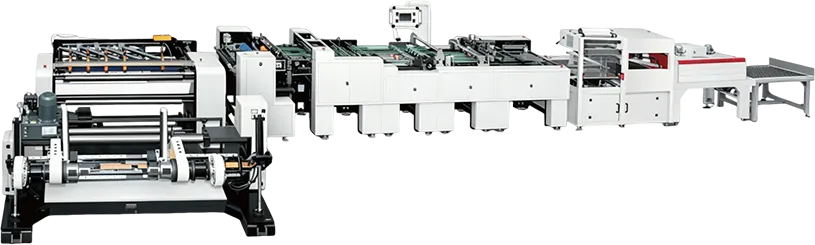
GAOBAO Sheeting Machine Options
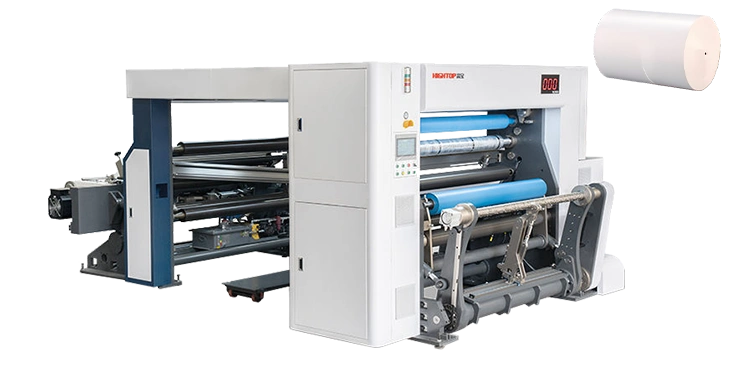
Zhejiang Gaobao Machinery Co., Ltd. (HIGHTOP) manufactures sheeting machines across multiple series. For detailed specifications, visit the Sheeting Machine product page.
GDHQ Series (Hobbing Die-Cutting Machine)
-
High-speed rotary sheeting
-
Hobbing die-cutting capability
-
Suitable for high-volume production
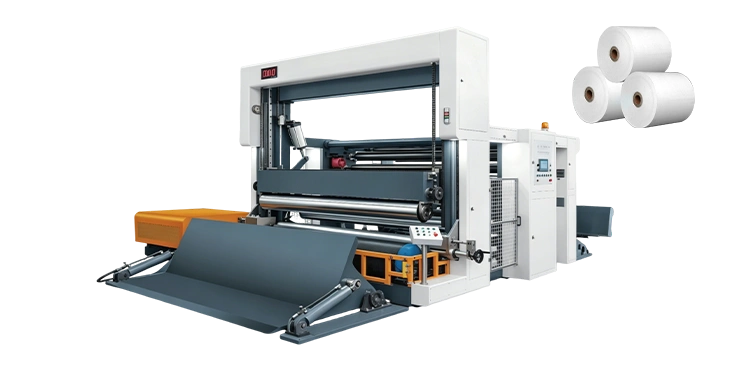
ZHQ Series (Auto-Stacking Sheet Cutting Machine)
-
Automatic stacking system
-
Ideal for operations requiring neat, consistent stacks
-
Reduces manual handling
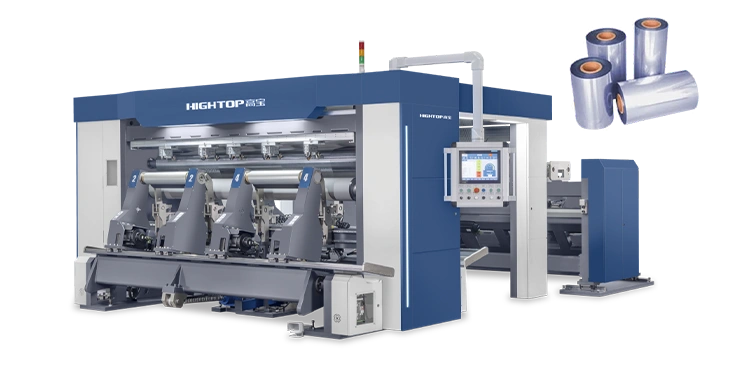
HQJ Series (Servo Cross Cutter)
-
Servo-driven precision cutting
-
Flexible sheet length range
-
Suitable for diverse materials
Each series is designed for specific production profiles. The GDHQ series excels in high-speed continuous production where precision and uptime are critical. The ZHQ series is optimized for operations where stacking quality is the priority—such as printing plants where sheet piles must feed reliably through presses. The HQJ series offers the flexibility needed for job-shop environments with frequent material and sheet size changes.For material-specific applications, HIGHTOP offers sheeting solutions for Paper, Label, Flexible Packaging, and Technical Applications.
Machine Selection Checklist
Use this checklist when evaluating sheeting machines:
- Material compatibility – Does the machine support your GSM range and material types?
- Width capacity – Does it accept your maximum parent roll width?
- Length range – Does it cover your required sheet lengths?
- Accuracy – Is the cutting accuracy (±0.5mm, ±0.25mm, or better) sufficient for your quality requirements?
- Speed – Does the speed meet your production targets?
- Feeding – Single or multi-roll?
- Stacking – Conveyor, automatic stacking, or pallet stacker?
- Controls – PLC with HMI? Recipe storage?
- Tension control – Closed-loop system with dancer or load cells?
- Dust management – Dust extraction for clean operation?
- Service support – Spare parts availability, technical support, training?
- Future expansion – Can the machine be upgraded for new materials or higher capacity?
When completing this checklist, prioritize based on your critical requirements. For a label converter processing 40–60gsm paper, cutting accuracy and speed may be the top priorities. For a packaging plant running 400gsm board, knife durability and stacking quality may be more important. The checklist helps identify trade-offs, not just requirements.
FAQ
What materials can a sheeting machine process?
Paper, kraft paper, coated paper, cup paper, duplex board, cardboard, foil, laminates, and certain plastic films. GSM ranges vary from 28gsm (Bible paper) to 800gsm (heavy board).
Rotary or guillotine – which cutting method should I choose?
Rotary sheeters are standard for high-volume paper converting, offering speed and clean cuts. Guillotine sheeters may be preferred for very thick board.
What is the typical cutting accuracy of a sheeting machine?
Entry-level: ±0.5mm. Mid-range servo-driven: ±0.25mm (length), ±0.5mm (squareness). High-end precision: ±0.1mm.
How does tension affect sheet quality?
Inconsistent tension causes length drift, width variation, curl, waviness, and uneven stacking. Proper tension control is essential for consistent sheet quality.
What information should I provide for machine selection?
Material type, GSM range, parent roll width and diameter, sheet length range, required accuracy, target speed, production volume, and preferred stacking method.
What is the difference between a sheeting machine and a slitter rewinder?
A slitter rewinder converts rolls into narrower rolls (longitudinal cutting). A sheeting machine converts rolls into flat sheets (cross cutting). Many converters use both.

 Sep 09,2026